Home › Game formats

48 different game formats

A student who plays the same game three hundred times stops thinking. So no two games in a row work the same way. Here is the whole range, grouped into eight families.

How the games work

Each family below is a way of asking a question. Inside it, each named format is a separate, finished game engine.
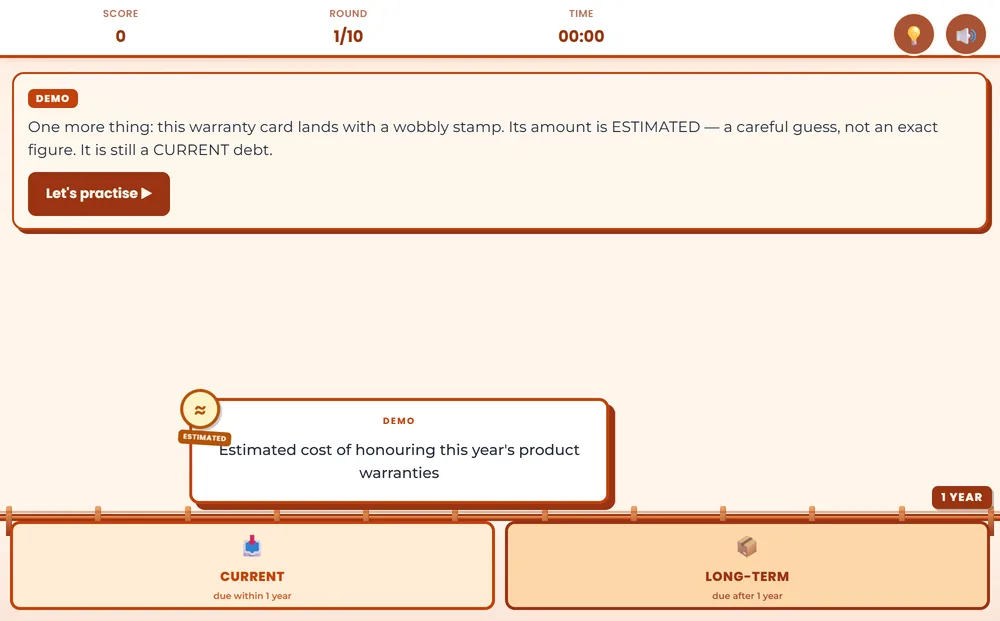
Sort it, fast in play, from CH10-G01
11 formats

Sort it, fast

Arcade sorting. An item appears - a transaction, an account name, a document - and the student sends it to the right bucket before the clock or the screen runs out. These build the instant recognition that everything later depends on.
Tap-Select Flash CardConveyor Belt SorterSpace Invaders DropperBalloon PopFruit Ninja SliceEndless RunnerWhack-a-MoleTarget ShooterBumper CarsCrazy Bird CannonTower Stacker
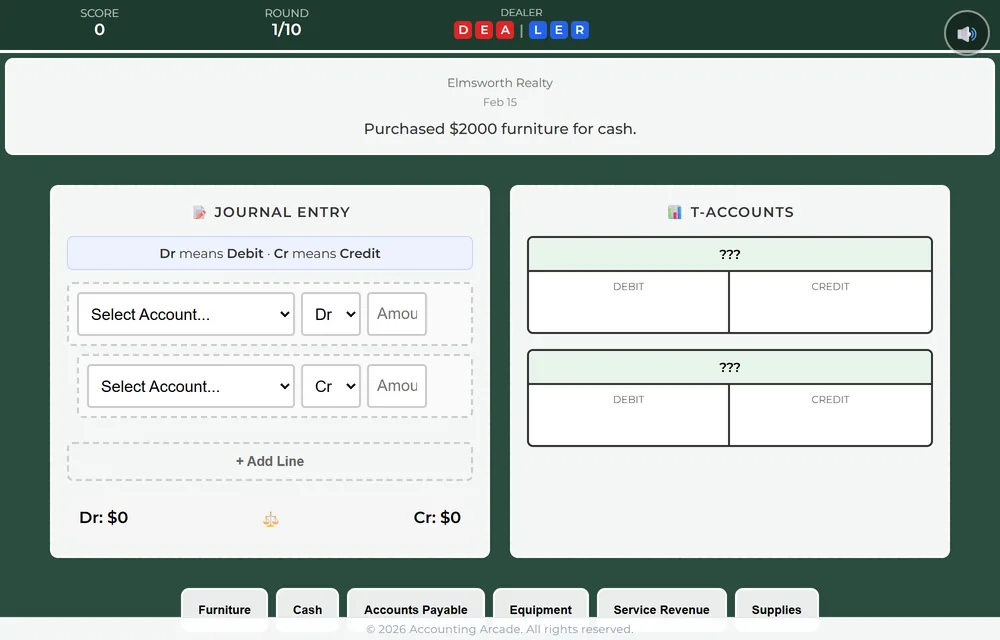
Build the journal entry in play, from CH2-G20
5 formats

Build the journal entry

The core skill of the whole course. The student picks the accounts, chooses the side, and enters the amounts - sometimes reading the figures straight off a realistic invoice or delivery note first.
Entry BuilderT-Account Complete EntryTap-Select Journal EntrySource-Document-to-EntryBuild the Books
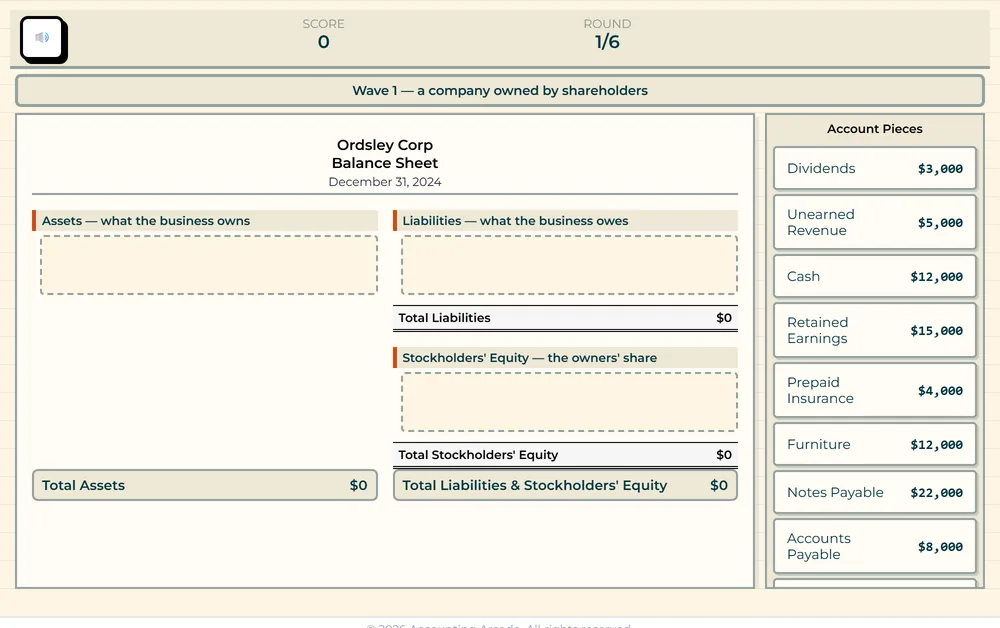
Build the statement in play, from CH1-G33
6 formats

Build the statement

A blank financial statement and a pile of accounts. The student places each one in the correct section, in the correct order, and the subtotals have to come out right.
Balance Sheet BuilderIncome Statement BuilderTrial Balance BuilderStatement Blueprint BuilderEquity Statement BuilderGrid Classifier
Work it out, step by step in play, from CH1-G07
10 formats

Work it out, step by step

Calculations that are shown as a shape, not a formula: a waterfall, a shrinking bar, a payment schedule that fills row by row. Each step is checked before the next one opens, so a student never carries a mistake forward.
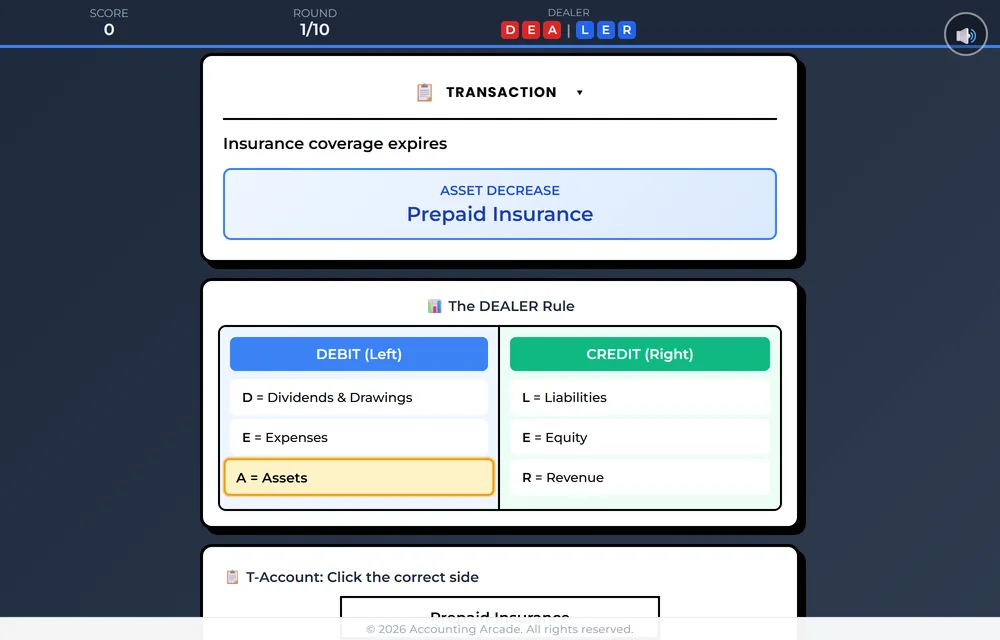
Waterfall CalculatorThree-Step EquationThree-Step Equation DrillTimeline Runway VisualizerAmortization Schedule BuilderTwo-Column Reconciliation BoardCost Stacking TowerVisual Deduction BarPercentage SliderT-Account Balance
Watch, then try in play, from CH2-G14
3 formats

Watch, then try

The teaching format. An animated diagram explains an idea one beat at a time - the DEALER chart, the nine-step cycle - and the student answers as it goes. These are where a new topic is introduced.
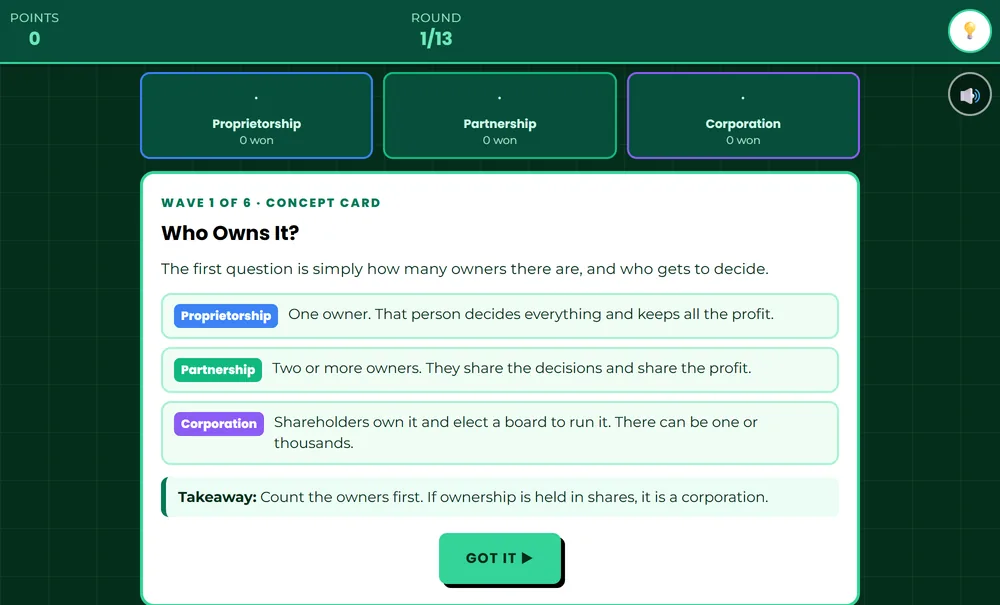
Visual Reference / TutorialBefore-and-After ComparatorLabel-the-Diagram
Check what you know in play, from CH1-G01
8 formats

Check what you know

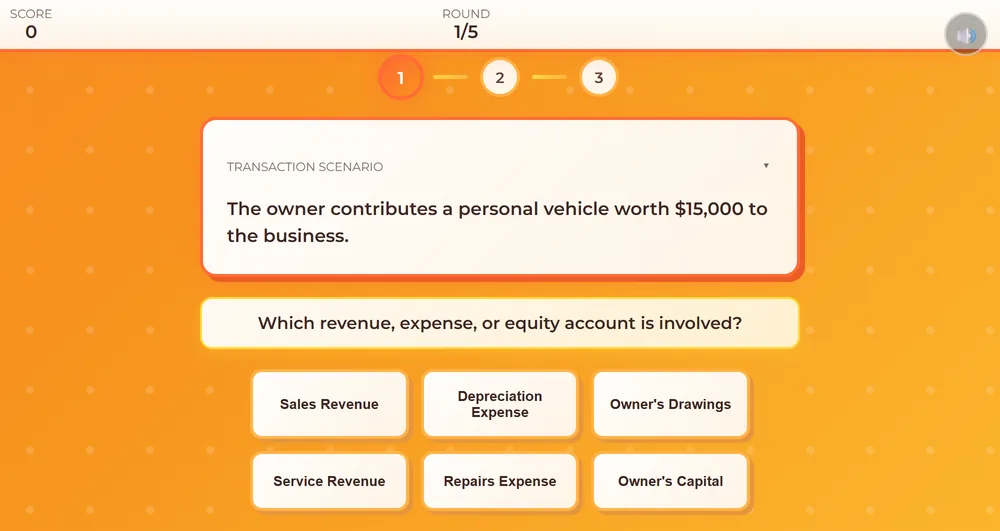
Recall and judgement. Multiple choice, choose-all-that-apply, matching pairs, yes-or-no calls, and grids where the student marks what goes up and what goes down. Used for openers, vocabulary, and end-of-chapter reviews.
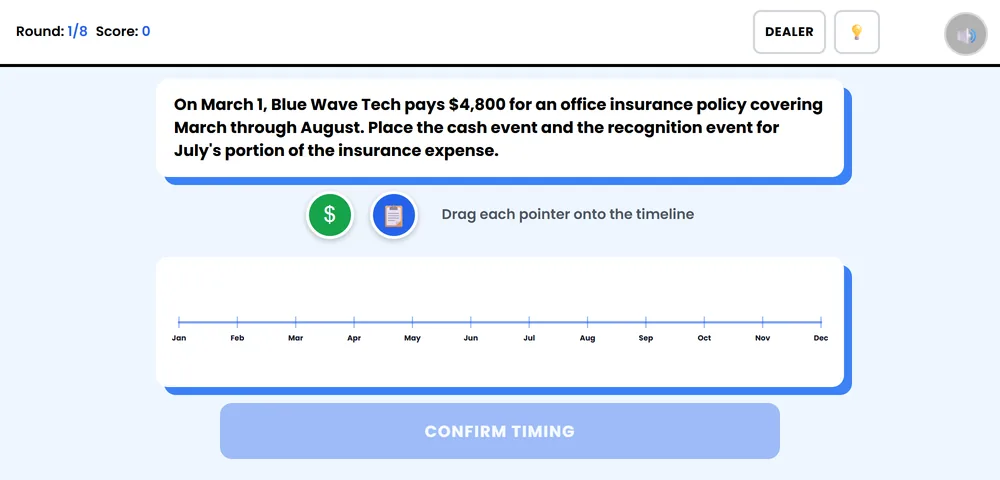
Multiple ChoiceMulti-SelectTap-MatchUp / No effect / DownEffect GridError ClassificationConcept RacingTwo-Step Concept and Case
See it across time in play, from CH3-G02
2 formats

See it across time

Two formats built for the ideas students find hardest: when cash moves versus when the work is really done, and how a mistake in one year quietly reverses itself in the next.
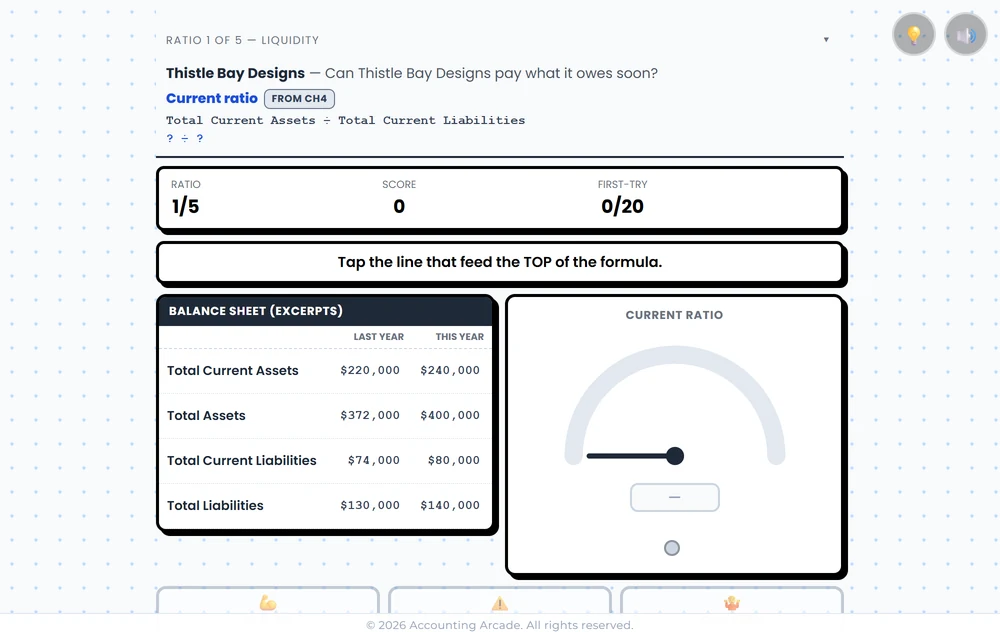
Cash-versus-Recognition TimelineTwo-Year Reversal
The big finish in play, from CH10-G16
3 formats

The big finish

Capstones. One long scenario runs through several stages - read it, record it, sort it, prove it - or a full analyst dashboard where the student picks the exact lines that feed a ratio.

Stage ComposerRatio DashboardError Eater

Every picture above is a real game, caught mid-play - not a drawing and not a mock-up. Better still, play one yourself: forty-one games are open to the public.

Same rules, every game

Tap, do not drag

Dragging is unreliable on a phone and unfair to a student with an older device. Every game is played by tapping.

Slow is not wrong

Timers make a game feel alive, but running out of time never costs a mark. Thinking is not punished.

Earn the help

Power-ups and bonuses are earned by getting things right. Nothing is bought, and nothing is hidden behind a purchase.

Marks come from the first try

A student can keep trying until a screen is right, and should. But the grade reflects what they knew the first time.

Explain, then use

A term appears in plain words first and only then in the language a textbook would use. Never the other way round.

Nothing borrowed

The businesses, names and figures in these games are our own inventions. The only real companies we name are the ones every textbook teaches - Enron, WorldCom, and the handful of cases like them - and we name those because they are public record.

Ask us anything

Want to see more, use these with your own students, or tell us something is wrong? Write to us. A real person reads every email.

Or just email david@accountingarcade.org. A real person reads every message, and we never pass your details to anyone.

Terms of Use

Effective Date: August 2026

1. Intellectual Property

All games, software, content, design, and materials on this website and within the Accounting Arcade SCORM game suite are the exclusive intellectual property of David van Brecht, trading as Accounting Arcade. All rights are reserved.

2. Demo Games

The demo games on this website are provided for evaluation. You may play them, and where we offer a sample package for download you may download it and load it into your own learning platform to try it with your class. That is what those packages are for.

You may not:

3. Licensed Products

The full Accounting Arcade game suite is available under a separate licence agreement. Licensed institutions may deploy the games on their own Learning Management System (LMS) for educational use by their students and staff. Full licence terms are provided upon purchase.

4. Prohibited Activities

You may not:

5. SCORM Compliance

Accounting Arcade games are designed to be SCORM 1.2 compliant. While we make every effort to ensure compatibility with standard LMS platforms, we cannot guarantee compatibility with all systems. We offer installation support to help ensure smooth deployment.

6. Limitation of Liability

This website and its content are provided "as is." Accounting Arcade shall not be liable for any indirect, incidental, or consequential damages arising from the use of this website or its products.

7. Contact

For licensing enquiries, support, or questions about these terms, please contact us at david@accountingarcade.org.

Privacy Policy

Effective Date: August 2026

1. Information We Collect

You can read this website and play every game on it without signing up, without an account, and without giving us your name or your email address. Nothing you do inside a game is sent to us.

The one place this website sends us anything about you is the contact form. If you choose to fill it in, it sends us what you typed: your name and your email address, and — only if you fill them in — your institution, what you would like help with, and your message. If you never use the form, we hold nothing about you at all.

Your message reaches us through a third-party form service, so what you type passes through their servers on its way to us. If you would rather not use the form, email us directly instead — the address is at the foot of every page.

Our pages load their typefaces from an external font service, so that service sees your IP address when a page loads. Beyond that we use no analytics, no tracking and no advertising.

2. How We Use Your Information

We use what you send us, through the contact form or by email, only to reply to you and — if that is what you have asked about — to arrange licensing and support. We do not sell your personal information, and we do not pass it to anyone beyond the form service that delivers your message to us.

3. Demo Games

The demo games on this website do not collect or store any personal data. When deployed via SCORM on your institution's LMS, any data collection is governed by your institution's own privacy policies.

4. Cookies

This website does not use tracking cookies or analytics services.

5. Contact

For privacy-related questions, contact us at david@accountingarcade.org.

Game